Replacing Your Social Security Card Without an Id: What You Can Use Instead
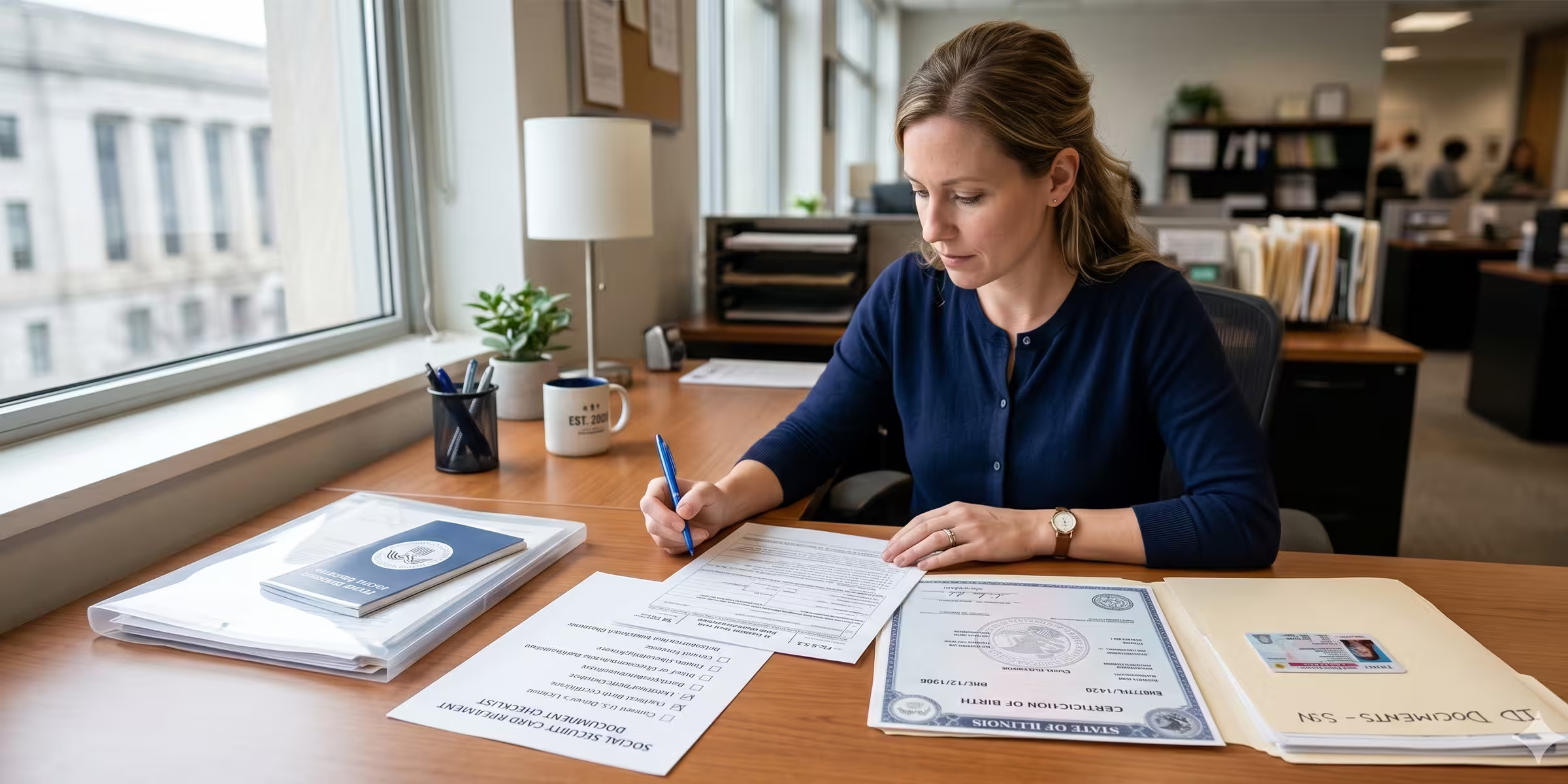



Most people assume a standard photo ID is a required document when replacing a Social Security card. It is not. The Social Security Administration (SSA) accepts alternative documents for identity verification when a standard driver's license or state-issued photo ID is unavailable. The challenge is knowing which alternatives qualify and how to assemble them in a way the SSA will accept.
Losing a Social Security card and a photo ID at the same time is not uncommon. Wallets get stolen. Cards get damaged. People move and lose track of documents across the chaos. The SSA has an identity verification system built around a tiered document approach, and photo ID is at the top of that tier, not the only option.
This guide explains what the SSA requires for identity when replacing a card, which non-photo documents qualify, how to prepare the Form SS-5 application package when standard ID is not available, and how GOV+ can help with this process.
The Social Security Administration requires applicants to prove three things when replacing a Social Security card: identity, age, and citizenship or immigration status. A photo ID satisfies the identity requirement but is not the only way to meet it. The SSA accepts non-photo documents as identity verification when photo ID is unavailable, including birth certificates with identifying information, school records, employee ID cards, military records, and health insurance cards.
Can you replace your Social Security card without a photo ID?
Yes. The SSA does not require photo ID specifically for a Social Security card replacement. What the agency requires is evidence of your identity, and that evidence can take many forms. A standard driver's license or state-issued photo ID is preferred because it is the easiest single document to present. When that document is unavailable, the SSA accepts alternatives.
The SSA's document policy for Form SS-5 uses a tiered list of acceptable identity documents. Documents that show your photograph are listed first because they are strongest for verification purposes. Documents that show personal information (name, date of birth, address) without a photo are also accepted.
One important constraint: the documents you submit must be original or certified copies. The SSA does not accept photocopies or notarized copies of originals in most situations. They inspect the originals and return them.
What the SSA actually requires for identity verification
The SSA evaluates three separate document requirements for a replacement Social Security card. Meeting all three is what completes the application.
1. Proof of identity. The SSA requires a current document showing your name, identifying information, and photograph. Acceptable photo ID documents include:
- U.S. passport or passport card
- U.S. driver's license
- State-issued identification card
If a photo ID is unavailable, the SSA may be able to accept one of the following instead:
- Employer identification card
- School identification card
- Health insurance card (not a Medicare card)
- U.S. military identification card
The SSA makes the determination on non-photo documents at the field office level. When relying on these alternatives, presenting multiple items strengthens the application.
2. Proof of age. A U.S. birth certificate is required if one exists, the SSA's language is explicit: if a birth certificate exists, you must submit it. If no birth certificate exists, the SSA may accept:
- A religious record made before age 5 showing your age or date of birth
- A U.S. hospital record of your birth, established before age 5
- A U.S. passport or passport card
3. Proof of U.S. citizenship. Acceptable documents include:
- U.S. birth certificate
- U.S. Consular Report of Birth Abroad
- U.S. passport or passport card
- Certificate of Naturalization
- Certificate of Citizenship
For most applicants who have lost their photo ID, a U.S. birth certificate satisfies both the age and citizenship requirements. The remaining gap is identity, which requires at least one of the non-photo alternatives listed above.
Secondary documents that can be used as a proof of identity
Secondary documents are only requested when primary evidence does not exist or cannot be accessed within 10 business days. Acceptable secondary documents for U.S. citizen adults include:
- U.S. Diplomatic or Official Passport
- U.S. military identification card (active duty, retiree, National Guard, or dependent)
- Certificate of Naturalization or Certificate of U.S. Citizenship
- U.S. government employee identification card (Form OF-55 or agency-issued equivalent)
- Non-government employee ID or badge card showing your name and either a photograph or your date of birth
- Certified copy of a medical record (clinic, doctor, or hospital) showing your name and date of birth or age. Must be certified by the custodian of record; self-maintained records are not accepted
- Health insurance or U.S. Medicaid card showing your name and either a photograph or your date of birth. A name-only health insurance card does not qualify
- School ID card or certified school record or transcript for the current school year, showing your name and either a photograph or your date of birth
- Life insurance policy showing your name and age or date of birth
What this means in practice:
A health insurance card only qualifies if it includes a photo or your date of birth, not name alone. The same applies to school and employee records: the document must connect your name to either your photograph or your date of birth to be usable as secondary identity evidence.
When relying on secondary documents, the SSA field office evaluates each case individually. Bringing multiple documents from this list strengthens the application and gives the representative more to work with.
What will not work as identity verification:
- Photocopies or notarized copies (originals or agency-certified copies only)
- Expired driver's licenses, state IDs, or passports (expired primary documents are generally not acceptable)
- The Social Security card being replaced (cannot serve as its own identity document)
- Immunization records (not accepted for applicants 18 and older)
- Self-maintained medical records or treatment receipts
The Form SS-5: what you are filling out and what it asks
Form SS-5 is the application form for a Social Security card, used for new cards, replacements, and name corrections. For a replacement, you complete the form and indicate that you are applying for a replacement card, not a new Social Security number. You then provide the documents that prove identity, age, and citizenship.
Key fields on Form SS-5 relevant to a replacement application:
- Your Social Security number (if you know it; SSA can look it up)
- Your full legal name as it appears on the card
- Your date of birth
- Your place of birth
- Whether you are a U.S. citizen
For most replacement applications, you submit the form in person at your local SSA field office. The office inspects your original documents and generally returns them after review. Follow the submission instructions provided by SSA for your specific situation regarding how and whether to present original documents.
You can find your nearest SSA field office and confirm current office hours at Field Office Locator. Offices are generally open Monday through Friday. Check your specific location for appointment requirements before you visit.
Some applicants may be eligible to request a replacement card online through the my Social Security portal without visiting a field office. The online option is generally available to U.S. citizens age 18 or older with a U.S. mailing address who meet SSA's eligibility criteria at the time of application. When applying with non-photo identity documents, an in-person visit is required in most cases so SSA can inspect the originals directly.
If you want help determining which documents apply to your specific situation before your SSA visit, GOV+ walks you through the preparation process, identifies what you need to bring, and organizes your Form SS-5 package so your application goes in complete the first time.
Does the SSA accept expired documents for a card replacement?
The SSA requires documents to be current and unexpired. An expired driver's license, state ID, or other identity document is generally not acceptable for a Social Security card replacement. If your identity documents have expired, renew or replace at least one before visiting your SSA field office.
If obtaining a current identity document before your visit is not feasible, contact your local SSA field office to explain your situation. The office can advise on whether any alternatives may apply in your case. GovPlus can help you review your document package before you go.
For a stronger application in any scenario, GovPlus can help you organize and review your document package before you visit the SSA field office.
How GOV+ Helps
GOV+ is designed to make sure Social Security card applicants arrive at their SSA field office with a complete, accurate Form SS-5 package so there are no missing documents or errors that require a second trip.
If you need to replace your Social Security card, here's how GOV+ can help:
- We prepare your complete Form SS-5 application package so you don't have to navigate the process on your own.
- Our expert reviewers check your application for errors and missing information before you go to your field office appointment.
- GOV+ walks you through exactly which identity, age, and citizenship documents to bring for your specific situation so nothing is missing when you arrive.
- Identity theft protection with up to $1M coverage.
Ready to get started? Replace your Social Security card with GOV+.
Frequently Asked Questions
Can you replace a Social Security card without a photo ID?
Yes. The SSA does not require photo ID specifically for a Social Security card replacement. What the agency requires is evidence of your identity, and that evidence can take multiple forms. A driver's license, state-issued non-driver ID, or U.S. passport are the preferred primary documents. When none of those are available, the SSA may accept secondary documents such as a U.S. military ID, a non-government employee ID card showing your name and photo or date of birth, a certified medical record, a health insurance card with a photo or date of birth, a school ID or transcript, or a life insurance policy. In most cases, presenting multiple secondary documents strengthens the application.
Can you replace a Social Security card without a driver's license?
Yes. A driver's license is the SSA's preferred identity document for adults, but it is not the only option. If you do not have a driver's license, the SSA will first ask whether you have a state-issued non-driver ID card or a U.S. passport. If none of those are available, secondary documents including a U.S. military ID, a non-government employee ID, a certified medical record, a qualifying health insurance card, a school record, or a life insurance policy may be accepted. The health insurance card must show your name and either a photo or your date of birth — a name-only card does not qualify.
What documents does the SSA require for a replacement Social Security card?
The SSA requires proof of three things: identity, age, and U.S. citizenship or immigration status. For identity, the SSA prefers an unexpired driver's license, state-issued non-driver ID, or U.S. passport. If those are unavailable, secondary documents may be accepted. For age, a U.S. birth certificate is required if one exists. For citizenship, acceptable documents include a U.S. birth certificate, U.S. Consular Report of Birth Abroad, U.S. passport or passport card, Certificate of Naturalization, or Certificate of Citizenship. All documents must be originals or agency-certified copies.
How many times can you replace a Social Security card in a year?
The SSA limits replacement Social Security cards to three per year and ten over a lifetime, with some exceptions for name changes, immigration status changes, and other qualifying circumstances. These limits apply to the card itself; your Social Security number does not change in a standard replacement.
Do you need to go in person to replace a Social Security card?
In most cases, yes. For applicants providing non-photo identity documents, an in-person visit to a local SSA field office is required so the agency can inspect original documents directly. Some applicants may be eligible to apply online through the my Social Security portal — the online option is generally available to U.S. citizens age 18 or older with a U.S. mailing address who meet SSA's eligibility criteria.
References
- Social Security Administration. "Social Security Card Replacement." SSA.gov. Accessed June 2026.
- Social Security Administration. "How to Apply for a Social Security Card." SSA.gov. Accessed June 2026.
- Social Security Administration. “Program Operations Manual System (POMS)” SSA.gov. Accessed June 2026