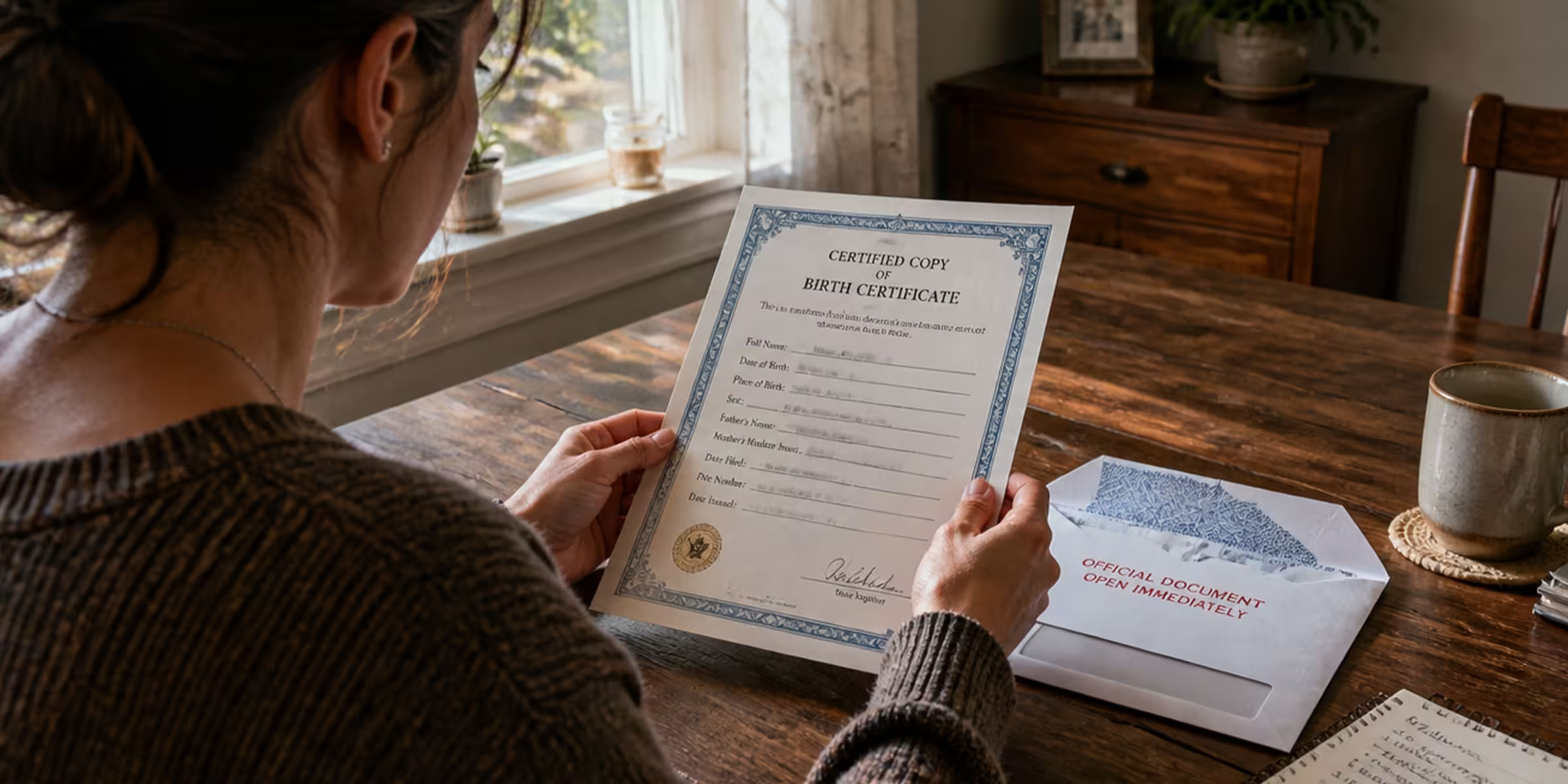



Birth certificates are issued by the state -- not a federal agency -- where you were born, and each state sets its own processing rules, fees, and turnaround times. Processing time varies by state; some official state pages list averages ranging from a few business days to several weeks, depending on the method you use to order and current office volume.
This article covers the factors that determine how long your specific request will take, including a 2026 state-by-state breakdown of processing windows for six high-volume states, the difference between standard and expedited options, how your ordering method (online, mail, or in-person) affects your total wait, what causes delays and how to avoid them, and how mailing time on both ends factors into your timeline.
Unlike U.S. passports, which the State Department issues, birth certificates are issued by the state, county, or city where you were born. There is no federal birth certificate office, no national processing window, and no single phone number for all 50 states. Each state's vital records office operates on its own schedule, with its own fees, its own accepted ID requirements, and its own turnaround times.
That decentralization has a practical implication: you order from the state where you were born, not where you currently live. If you were born in Ohio but live in Arizona, you order from Ohio's vital records office, follow Ohio's rules, and pay Ohio's fee.
The GOV+ birth certificate process is built around this state-by-state reality -- GOV+ prepares your application using the correct form for your state of birth, so you don't have to navigate multiple state websites to find what applies.
Birth certificates are issued at the state or local level, and each office publishes its own processing estimates rather than guarantees. The figures below come directly from official state vital records pages. Some states publish a single estimate; others break out times by ordering method. Mailing time on both ends is separate and covered in a later section.
Illinois fee note: IDPH lists $10 for a standard certified copy and $15 for a copy that includes information collected at the time of birth. Confirm which version you need before ordering.
New York City vs. New York State: If you were born in one of the five boroughs -- Manhattan, Brooklyn, Queens, the Bronx, or Staten Island -- your order goes to the NYC Department of Health and Mental Hygiene, not the state office in Albany. NYC publishes its own processing windows (above) and these differ significantly from upstate processing times. NYC online orders run 2 to 3 weeks; mail orders run approximately 12 weeks.
California: CDPH-VR's published average is 5 to 7 weeks from the date the office receives your request. The processing clock starts at receipt, not submission, so mail transit time is added on top. County vital records offices often process requests faster than the state office; if you are in or near your county of birth, calling your county office first is worth the effort.
Texas: DSHS publishes a current processing-time page showing 20 to 25 business days for birth certificates, with a second column extending to 25 to 30 days for some requests. That translates to roughly 4 to 6 weeks depending on current volume. Walk-in same-day service is available at the DSHS Austin office.
New York State (outside NYC): The NY Department of Health's vital records page currently states the office is experiencing significant delays and has not published a specific estimate. Order as early as possible and plan for a longer wait than comparable states.
Illinois: IDPH states processing is approximately 12 weeks from receipt. That is substantially longer than most states and should be factored into any deadline planning.
Pennsylvania: The PA Department of Health states that both online orders placed through mycertificates.health.pa.gov and paper applications mailed to the Division of Vital Records take approximately 2 weeks.
South Carolina: The SC Department of Public Health publishes method-specific estimates: 5 to 7 business days for online or phone requests, 2 to 4 weeks by mail, and approximately 30 to 45 minutes for in-person visits.
If you need a birth certificate to support a passport application and need to understand your fastest options, the GovPlus guide to ordering a replacement birth certificate for passport renewal walks through all three ordering paths side by side.
Standard processing is the default timeline published by the state. Your order enters the regular queue and is processed in the order it was received. The timeframes in the table above are standard processing windows.
Expedited processing moves your order ahead of the regular queue, where the state offers it. There are three forms:
In-person same-day service. Some states let you walk into a county vital records office, show valid government-issued ID, pay the fee, and walk out with a certified copy the same day. This is often the fastest state-run option available, and it has nothing to do with your mail order -- you are physically present at the office. Availability depends on which county you visit and what hours the office runs on any given day. Call ahead before making the trip.
Expedited mail-processing tier. Some states offer a faster queue for online and phone orders, where your request can be processed faster than standard service, sometimes within a few business days, depending on the state. This usually costs an additional fee on top of the standard certificate fee. Not every state offers this tier; check the specific vital records site for your state of birth.
Third-party courier or state-authorized services. A small number of state offices work with courier services that may offer expedited shipping after the certificate is issued. This option is rare and typically costs significantly more than standard or expedited processing.
One point that causes real confusion: expedited processing means the state handles your request faster. It does not guarantee the finished certificate arrives at your door faster unless you also select expedited return shipping. State processing and postal delivery are two separate legs of the journey.
If you are ordering a birth certificate because you also need to apply for a passport, note that the same time-pressure logic applies to both. Applying for a passport through GOV+ lets you stack both applications in the same account, so you are not repeating data entry across two separate processes.
Yes, and meaningfully so. The three standard order methods carry different speed profiles.
Online or phone orders are the fastest for most states. Once your completed application is received and validated, it enters the state's digital processing queue without the transit delay of a paper form traveling through the mail. Most states with functioning online portals process online orders faster than mail-in requests, though the difference varies by state -- in some cases it is a few business days, in others it can be several weeks. If you have a deadline, this is the path to use.
Mail orders are slower for two reasons. First, your application has to physically travel to the state's vital records office before it enters the processing queue, adding transit time at the beginning. Second, the certified copy has to travel back to you after the state processes it, adding more time at the end. As an example, a mail order that takes three weeks in processing could take five weeks or more total once you account for both legs, depending on your location and shipping method.
In-person walk-in is the fastest option overall where it is available, because you bypass the mail queue and the processing queue entirely. You show up with your ID, pay the fee, and the clerk issues the certified copy at the counter. The limitation is purely geographic and logistical: you have to be in or near the right county, during the right hours, and the office has to have walk-in availability that day.
What changes when you order through GOV+? GovPlus prepares your application with the correct form for your state of birth, handles the identity-verification step that many states require, and routes a complete application packet to the vital records office. The GOV+ birth certificate kit reduces the risk that the office returns your application as incomplete, which is the single most common source of unexpected delays. The state then processes the request on its own timeline and mails the certified copy directly to you. GovPlus does not change or control how long the state takes; it improves the odds that your application goes through on the first pass.
What changes when you order through GOV+? GovPlus prepares your application with the correct form for your state of birth, handles the identity-verification step that many states require, and routes a complete application packet to the vital records office. The GOV+ birth certificate kit reduces the risk that the office returns your application as incomplete, which is the most common source of unexpected delays. The state then processes the request on its own timeline and mails the certified copy directly to you. GovPlus does not change or control how long the state takes; it improves the odds that your application goes through on the first pass.
Most birth certificate delays fall into one of four categories. Knowing them in advance lets you avoid the ones that are preventable.
Incomplete or incorrect applications. This is the most common delay and the most preventable. State vital records offices will return an application if required information is missing, if the submitted ID is not on their accepted list, or if the notarization (where required) is deficient. Depending on the state, a returned application can add 2 to 4 weeks to your total timeline: you wait for the return notice to reach you, correct the issue, resubmit, and wait again for the corrected application to be processed. Confirming your state's exact requirements before you submit eliminates this risk almost entirely.
Name discrepancies between your ID and the birth record. If the full name on your current government-issued ID does not match the name on the birth record, the state may put your order on hold and request supporting documentation before it releases the certified copy. This happens most often with legal name changes, hyphenated names, and records where a first or middle name was shortened or formalized over time. If you know there is a discrepancy, gather the supporting documentation before you submit, not after the state flags the problem.
Volume surges. Tax season, back-to-school enrollment periods, and deadlines tied to REAL ID enforcement all drive spikes in birth certificate orders. States do not always scale processing capacity in proportion to volume, so published turnaround estimates may stretch during high-demand periods. If you are ordering during a predictable surge, build extra buffer time into your planning. The four weeks before summer travel season is a historically busy window for vital records offices.
Records that predate digital systems. Births from before the mid-1940s and some from the 1950s may not be fully digitized in every state. Retrieving a pre-digital record requires a records clerk to locate a physical ledger, which takes longer than pulling a digital file. If you are ordering a birth certificate for a family member born in an earlier decade, allow for the possibility that the request may take longer than the state's standard window.
Processing time and delivery time are not the same thing, and the gap between them matters when you have a real deadline to hit.
Here is how to build a full timeline:
For mail orders: Your application has to physically travel to the state office before processing begins, and the certified copy has to travel back to you after the state finishes. Both legs add time on top of the state's published processing window. How much time depends on your location, the state office's location, and the shipping method you use.
As an example, a state with a 12-week processing window like Illinois will have a meaningfully longer total wait than a state like South Carolina, where online processing runs 5 to 7 business days -- but in either case, the mailing legs are separate from what the state publishes.
For online orders: You skip the outbound mail leg entirely. Your completed application is in the state's queue as soon as it is received and validated, which removes at least one transit delay from your total timeline. The return leg -- the state mailing the certified copy to you -- still applies. In states where online processing is significantly faster than mail-in, the total time savings can be substantial; in others, the difference is smaller.
For in-person walk-in: Same-day where available. There are no mail legs. The only time cost is the trip itself.
Need a copy of your birth certificate? GOV+ simplifies every step, so there's no guesswork or rejected applications.
And applying for a birth certificate through GOV+ sets you up for every government application you may need from now on. Our autofill technology stores your information and automatically pre-fills future forms, so you never have to start from scratch again.
Apply for a birth certificate today.
Order your birth certificate as early as possible -- ideally before you start the passport application, or in parallel with it. Processing time varies by state and ordering method; some official state pages list averages ranging from a few business days to several weeks for standard service, plus additional time for the certified copy to reach you by return mail. The State Department's standard passport processing time is several weeks for routine service, not counting mailing time. If you need both documents, starting both requests at the same time is the most efficient approach. Waiting to order the birth certificate until after you have started the passport application can add meaningful time to your total timeline.
Yes, in some states and counties. South Carolina, for example, lists in-person processing at approximately 30 to 45 minutes. California, Pennsylvania, and several other states also offer walk-in service at county vital records offices where you may be able to receive a certified copy the same day you visit, as long as you bring valid government-issued ID and pay the required fee. Availability varies by state, county, and office. Call the specific office before making the trip, because walk-in service policies and hours can change without public notice.
Generally yes, compared with mail-in orders. Once your completed application is received and validated, it enters the state's processing queue without the transit delay of a paper form traveling through the mail. The difference varies by state -- in some cases it is a few business days, in others it can be several weeks. If you have a deadline and in-person walk-in is not an option, online ordering is typically the faster path.
A certified copy is an official record issued directly by the state vital records office. It carries the registrar's raised or embossed seal and an official signature, which confirm it is an authenticated government record. A non-certified or informational copy may lack those features and is not accepted by government agencies as proof of identity or citizenship. For passport applications, REAL ID, Social Security card requests, name changes, and most government purposes, you need the certified copy specifically. A commemorative birth certificate from a hospital or a photocopy of an old document will not meet agency requirements.
Currently, yes. The New York State Department of Health's vital records page states the office is experiencing significant delays and has not published a specific processing estimate. If you were born in New York State outside of the five NYC boroughs, order as early as you can and plan for a longer wait than most other states. New York City residents should note that Manhattan, Brooklyn, Queens, the Bronx, and Staten Island are handled by the NYC Department of Health and Mental Hygiene, not the state office in Albany. NYC publishes its own processing windows: online orders run approximately 2 to 3 weeks, while mail orders run approximately 12 weeks.
The state mails you a return notice explaining what is missing or incorrect. You correct the issue and resubmit. Depending on the state and its current volume, that resubmission cycle adds meaningful time to your total wait -- time for the return notice to reach you, time to correct and resubmit, and time for the corrected application to be processed. The most common reasons for return are missing or unacceptable ID copies, missing notarization where required by the state, incorrect or missing fees, and applicant relationship information that does not match state eligibility rules. Confirming your state's specific requirements in advance and submitting a complete application on the first pass is the best way to avoid the delay.
Most online portals accept payment by credit or debit card through a secure payment portal. Mail-in requests typically require a check or money order made out to the state vital records office. Submitting the wrong payment method is one of the more common reasons an application is returned, so confirm what your state accepts before you submit.
Yes. Most states let you request more than one certified copy in a single application by paying the per-copy fee for each additional copy. If you expect to need a certified copy for a passport, a driver's license update, or benefits enrollment, ordering extras upfront is more efficient than submitting a separate request later and restarting the processing clock.
A birth certificate documents a person's full name, date of birth, place of birth, and parents' names. A death record documents the date, location, and cause of death. Both are vital records held at the state or local level, and in most states the same vital records office handles both -- but eligibility rules and processing times differ, and each is submitted as a separate application.
Most states require a copy of a valid government-issued photo ID -- a driver's license, state ID, or passport -- along with the basic details of the record: the full name on the certificate, date of birth, place of birth, and your relationship to the person named. Some states also require a notarized sworn statement. If you lack standard photo ID, some states accept alternatives such as bank statements or a notarized letter from a birth parent, though accepted documents vary by state.


1,500,000+









© 2026 EIN Plus LLC DBA GovPlus. All rights reserved. GovPlus® is a registered trademark of EIN Plus LLC.
GovPlus® is a private online software technology company not affiliated nor endorsed by any Government or State agency. GovPlus® is authorized by the U.S. Department of State, through its subsidiary Premier Passports LLC as a registered passport courier, by the Internal Revenue Service (IRS) as an authorized e-file provider, by the Financial Crimes Enforcement Network (FinCEN) as a Beneficial Ownership Information (BOI) provider. We do not charge for any forms; however, we charge for the use of our software to assist you in completing forms. GovPlus® is not a federal or state agency, financial institution, accounting firm, or law firm, and we do not provide legal or financial advice. GovPlus® does not issue any government documents. You can apply directly for government services at their official websites at no cost beyond government fees.
Terms and conditions, features, support, pricing, and service options subject to change without notice.