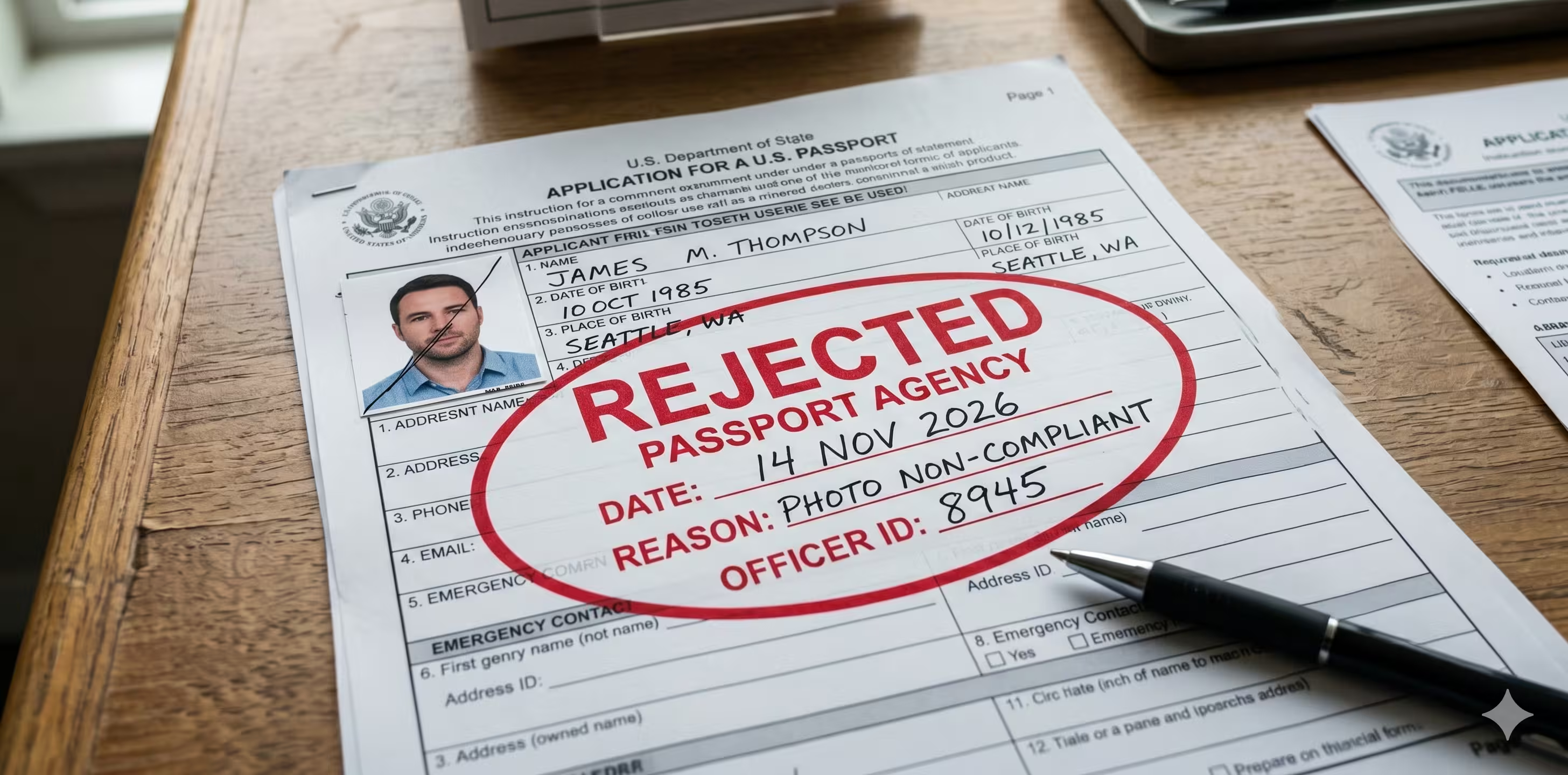
TSA PreCheck Application Denied? Here's What to Do Next and How to Appeal



The short answer
If your TSA PreCheck application was denied, you have three main options: wait for an interim disqualifier to age out, file a formal appeal with TSA to correct a mistake or request reconsideration, or submit a redress request through the Department of Homeland Security's Traveler Redress Inquiry Program (TRIP) if you were flagged due to a misidentification.
The right path depends on why you were denied. Most denials fall into one of three categories: a disqualifying criminal offense, a prior TSA security violation, or a fixable application-level error such as a name mismatch or incomplete address history.
This guide explains how to identify your denial type, which steps to take, and how GOV+ can help you avoid the application mistakes that cause most preventable denials. If you are ready to refile now, you can start a corrected TSA PreCheck application and let GOV+ review your information before you submit.
First: figure out which kind of denial you received
When TSA denies a PreCheck application, it sends a Preliminary Determination of Ineligibility (PDOI) letter by mail or email. The PDOI explains the reason for the denial and your rights to respond, and it opens a 60-day window to file a formal appeal. Read it carefully before taking any action — the denial reason determines everything that follows.
TSA PreCheck applications are denied for three main reasons:
- Disqualifying criminal offense. Certain felonies and misdemeanors appear on TSA's published list of disqualifying offenses. Some are permanent bars. Others disqualify you for a set number of years after conviction or release from incarceration. [1]
- TSA security violation. A prior incident at a checkpoint — such as a confirmed intent-to-harm attempt or a serious security breach — can result in denial independent of your criminal history. [1]
- Application-level issue. A misspelled name, incorrect Social Security number, unverifiable address history, or a mismatch between application data and the ID presented at your enrollment appointment. These denials are fixable without a formal appeal.
There is a fourth possibility that will not appear in the denial notice: your name or date of birth may match someone else on a federal watchlist. This is a misidentification case. The fix runs through DHS TRIP, not through TSA's appeal process, and requires a separate redress request.
TSA PreCheck disqualifiers: the published list
TSA's PreCheck program has a published list of disqualifying offenses. [1] The list groups offenses into two buckets:
Permanent disqualifiers
Convictions for these offenses permanently disqualify you from TSA PreCheck:
- Espionage or conspiracy to commit espionage.
- Sedition or conspiracy to commit sedition.
- Treason or conspiracy to commit treason.
- A federal crime of terrorism.
- Improper transportation of a hazardous material under 49 U.S.C. Section 5124.
- Unlawful possession, use, sale, distribution, manufacture, purchase, receipt, transfer, shipping, transporting, import, export, storage of, or dealing in an explosive or explosive device.
- Murder.
- Threat or maliciously conveying false information about the delivery, placement, or detonation of an explosive.
- Violations of the Racketeer Influenced and Corrupt Organizations Act (RICO), 18 U.S.C. 1961 et seq., or violations of state statutes comparable to RICO, where one of the predicate acts in a pattern of racketeering activity is one of the permanent disqualifiers listed above.
- Attempt to commit the crimes in items (1)-(4) of this section.
- Conspiracy or attempt to commit the crimes in items (5)-(10) of this section.
Interim disqualifiers (within the past 7 years, or while incarcerated or on parole)
Convictions for these offenses disqualify you for a limited period:
- Unlawful possession, use, sale, manufacture, purchase, distribution, receipt, transfer, shipping, transporting, delivery, import, export of, or dealing in a firearm or other weapon.
- Extortion.
- Dishonesty, fraud, or misrepresentation, including identity fraud and money laundering, where the money laundering is related to a crime described in this paragraph. Welfare fraud and passing bad checks do not constitute dishonesty, fraud, or misrepresentation for this purpose.
- Bribery.
- Smuggling.
- Immigration violations.
- Distribution, possession with intent to distribute, or importation of a controlled substance.
- Arson.
- Kidnapping or hostage taking.
- Rape or aggravated sexual abuse.
- Assault with intent to kill.
- Robbery.
- Fraudulent entry into a seaport under 18 U.S.C. 1036.
- Voluntary manslaughter.
- Conspiracy or attempt to commit any of the above crimes.
An active arrest warrant or open indictment for any felony on TSA's permanent or interim disqualifier list will result in automatic denial This applies to both civilian and military jurisdictions. The disqualification remains in effect until the warrant is released or the indictment is dismissed — there is no appeal path while the warrant or indictment is active.
Note: TSA PreCheck disqualifiers are not identical to Global Entry disqualifiers or to HAZMAT Endorsement disqualifiers. Each Trusted Traveler Program has its own criteria. Being denied one does not automatically deny the others, though the overlap is significant. [2]
What you can do if your denial is for a disqualifying criminal offense
If TSA denied your PreCheck application based on a criminal record, the first question is whether the disqualifier is permanent or interim. The answer determines whether an appeal is worth filing at all.
- If the disqualifier is permanent: there is no appeal path that leads to TSA PreCheck approval; however, if there is documented legal action (expungement/pardon) that alters the underlying record, applicants may submit that documentation in an appeal.
- If the disqualifier is interim and the 7-year window has not yet elapsed: wait. No formal action is required. The clock runs from the date of conviction or release from incarceration, whichever is later. Reapply once the window closes and expect a cleaner result.
- If the disqualifier is interim and the 7-year window has already elapsed, or at least 5 years have passed since your release: your denial may not be valid. File a formal appeal with TSA within 60 days of receiving your Preliminary Determination of Ineligibility (PDOI) letter. Request the Materials letter from TSA first — they will send it on request — then submit a written response that includes certified copies of your court records and any other supporting documentation. Appeals at this stage typically take several months. If TSA approves the appeal, you can reapply for PreCheck, frequently at no additional cost. [3]
- If your offense was expunged, pardoned, or downgraded to a non-disqualifying charge: expungements, pardons, and charge downgrades are all recognized grounds for appeal. Include certified court records that document the expungement, pardon, or downgrade with your written appeal response. [3]
What if your denial is for a TSA security violation
TSA security violations are evaluated separately from criminal history. If your denial cites a prior checkpoint incident, the appeal process follows the same path as a criminal record appeal — Request for Materials, then a written response — but the evidence you need is different.
For a security violation appeal, gather everything you have from the original incident: the incident report, any witness statements, correspondence with TSA at the time, and any other documentation that speaks to what actually happened. TSA reviews the full record and decides whether the violation should continue to bar enrollment. There is no formula for success; the outcome depends entirely on the specifics of the incident and the strength of the documentation you submit. [3]
If your denial is for an application-level issue
Application-level denials are the most fixable. Common issues:
- Name mismatch: the name on your TSA application did not match the name on the ID you brought to the enrollment appointment. Fix: reapply with a corrected name and bring matching ID.
- Address history gap: you could not account for every month in the last five years. Fix: research older addresses through a utility provider, a bank, or a former landlord, and refile.
- Employment gap: a gap in employment history or a hard-to-verify past employer. Fix: add clarifying notes on refiling.
- Citizenship documentation problem: the citizenship document you submitted was not accepted. Fix: obtain a certified U.S. birth certificate or valid U.S. passport and refile.
For these cases, you usually do not file an appeal. You fix the underlying issue and reapply as a new application. The $78 enrollment fee is not refunded, so the fix needs to include the root cause, not just a retry with the same data.
This is exactly the scenario where a service like GOV+ pays for itself. The intake walks through the address history, the employment history, and the name match against your ID before you submit. The citizenship document upload is reviewed before your enrollment appointment, so you do not show up with a birth certificate that TSA will reject. For applicants whose first denial was a fixable error, a guided reapplication is often the difference between a second $78 fee thrown away and a KTN in your email a few weeks later.
If you were denied by mistake: DHS TRIP (Traveler Redress Inquiry Program)
If your denial notice does not cite a disqualifying offense or a security violation, you may be dealing with a misidentification. This happens when your name or date of birth closely matches someone else on a federal watchlist. The denial itself will not say this — it is something you have to rule in or out based on what the notice does not say. [4]
The fix runs through the Department of Homeland Security's Traveler Redress Inquiry Program (DHS TRIP), not through TSA's appeal process. File a redress request at dhs.gov/trip, submit your ID documents, and explain the mismatch. If DHS confirms the misidentification, they issue a Redress Control Number (RCN) — a 7-digit identifier that is separate from the Known Traveler Number (KTN) you receive when enrolled in TSA PreCheck.
The two numbers serve different purposes and are easy to confuse. The RCN tells TSA and airlines that your identity has been cleared through the redress process. The KTN tells TSA you are an enrolled PreCheck member. Both go in the same field on airline reservations and Trusted Traveler Program applications, but only the KTN grants PreCheck screening benefits. If you receive an RCN through TRIP and later apply for TSA PreCheck, include the RCN on your new application.
DHS TRIP redress typically takes several months and is free. [4]
Appeal timelines and cost comparison
Any of these can be stacked with a reapplication. For example, you can file a TRIP redress while you wait for a disqualifier to age out, so that by the time you reapply, both tracks have cleared.
How GOV+ can help with a TSA PreCheck reapplication
GOV+ does not change TSA's approval criteria. What it does is reduce the risk that your second application gets denied for the same application-level issue that caused the first denial — which is the most common reason applicants pay the $78 fee twice without getting approved.
Here is what the GOV+ intake process covers before you submit:
- Address and employment history review. Guided prompts walk you through every required period and flag likely gaps before submission.
- Name match check. Your name fields are verified against the ID you plan to bring to the enrollment appointment, catching the mismatch that is one of the most common fixable denial reasons.
- Citizenship document review. Your documents are checked before the appointment so you do not arrive with paperwork TSA will reject.
- Appointment booking. GOV+ schedules your enrollment appointment at the nearest available slot, removing the delay between application submission and scheduling.
- Redress Control Number capture. If you received a DHS TRIP Redress Control Number from a prior misidentification case, GOV+ stores it in your application and your account for future Trusted Traveler Program applications.
If your denial cited a disqualifier on TSA's published list, no reapplication service changes the eligibility outcome. That is a rules question, not an execution question. GOV+ is most valuable for applicants whose denial was application-level and those whose interim disqualifying offenses have times out.
Does that sound like you? Get started here.
Frequently asked questions
Can you get TSA PreCheck with a felony?
Sometimes. It depends on the specific felony. Permanent disqualifiers include murder, treason, espionage, and terrorism offenses. Other felonies are interim disqualifiers: you are ineligible for 7 years after the conviction or release, whichever is later. Some felonies are not on the disqualifier list at all. The full list is published by TSA. [1] If your felony is not on the list and you were still denied, GOV+ can help you prepare a corrected reapplication that closes the application-level gaps TSA actually flagged.
Can you get TSA PreCheck with a misdemeanor?
Usually yes. Most misdemeanors are not on TSA's disqualifier list. The exceptions are dishonesty offenses and certain fraud-related misdemeanors. If your misdemeanor does not appear on the published list, your denial is likely tied to an application-level error or a watchlist misidentification — both of which are appealable or correctable without waiting out a disqualifier period.
How long does a TSA appeal take?
A formal TSA appeal typically takes two to three months. Straightforward appeals — such as an expired interim disqualifier with clean court records — can resolve in as little as 60 days. Appeals involving contested criminal records or disputed security violations can run longer than six months.
Does Global Entry approval override a TSA PreCheck denial?
Yes. Global Entry includes TSA PreCheck benefits. If you were denied TSA PreCheck but later approved for Global Entry, your Global Entry membership gives you PreCheck screening access through the same Known Traveler Number. CBP applies different eligibility criteria than TSA, so applicants denied by TSA are sometimes approved by CBP through the Global Entry process. [2]
Can I reapply for TSA PreCheck right after a denial?
You can, but reapplying without fixing the root cause will produce the same denial. The $78 enrollment fee is not refunded on a second denial. Wait until you have resolved the underlying issue — whether that means a disqualifier aging out, an appeal outcome, a redress number from DHS TRIP, or a corrected application. GOV+ can help you identify and fix application-level errors before you pay the fee again.
What if my denial was for something that happened 10+ years ago?
Most interim disqualifiers carry a 7-year clock. If the offense is more than 10 years behind you, the denial may be a mistake, or TSA may be citing a different offense than the one you are thinking of. Request your file through the TSA appeal process to see exactly what record is being used as the basis for the denial.
References
- Transportation Security Administration. TSA PreCheck Disqualifying Offenses. https://www.tsa.gov/disqualifying-offenses-factors
- U.S. Customs and Border Protection. Trusted Traveler Programs. https://www.cbp.gov/travel/trusted-traveler-programs
- Transportation Security Administration. TSA PreCheck Application Denied or Revoked. https://www.tsa.gov/precheck/disqualifying-offenses-factors
- U.S. Department of Homeland Security. Traveler Redress Inquiry Program (TRIP). https://www.dhs.gov/trip