Who Do You Need to Notify When You Change Your Address? The Full List




When you change your address, you need to notify the U.S. Postal Service, the IRS, the Social Security Administration, your state DMV, your employer, your financial institutions, and any private accounts that hold your address on file. USPS mail forwarding does not update these records automatically.
If you want help updating your address across all the key agencies at once, GOV+ can help guide you with pre-filled forms for USPS, IRS, SSA, DMV, and more so you don't have to track down each one separately.
The following covers every agency and institution you need to notify, in priority order, with deadlines and how to update each one.
The agencies to notify when you change your address, in priority order
Start with USPS to forward mail while you work through the rest of the list. Then move to federal agencies, then state agencies, then private accounts. This order ensures that correspondence from agencies you have not yet updated still reaches you during the transition period.
Does the USPS forward your mail automatically after a change of address?
Yes, with an important limitation. When you file a change-of-address request with the U.S. Postal Service, the agency forwards first-class mail from your old address to your new one for a period of 12 months. Magazines and periodicals forward for 60 days. Standard mail (catalogs, bulk mail) is not forwarded.
The USPS change-of-address is a forwarding service, not a permanent address update. Senders who receive returned mail or notice the forwarding address flag may update their records. Those who do not will continue sending to your old address. Mail forwarding ends after 12 months.
You can file a USPS change of address online at usps.com/move for a $1.25 identity verification fee, or free in person at any Post Office with a completed PS Form 3575. The online process completes the same-day. The in-person process completes within a few business days.
Filing with USPS does not update your address with the IRS, SSA, DMV, or any other agency. Each requires its own separate notification.
How do you update your address with the IRS and Social Security Administration?
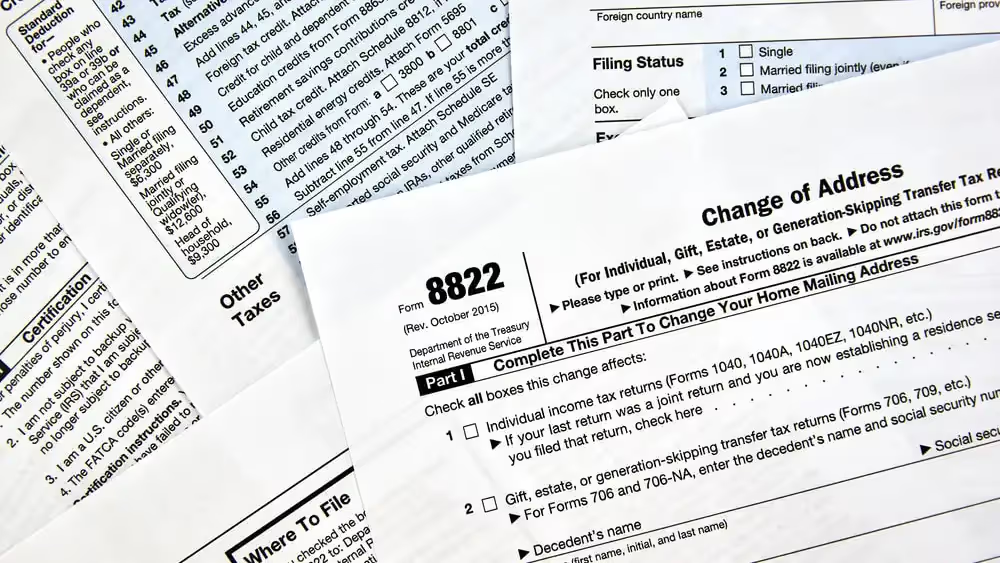
IRS. File Form 8822 (Change of Address) for individuals, or Form 8822-B for businesses and trusts. This is a short form mailed to the IRS address listed in the instructions. The IRS also accepts an address update on your next filed tax return; your new address on Form 1040 updates the IRS record for that return year. The IRS recommends filing Form 8822 proactively rather than waiting for the next return, particularly if you are expecting any correspondence.
The IRS sends notices and refund checks to the address on your most recent return. If you moved after filing and before receiving a notice or refund, filing Form 8822 redirects that correspondence to your new address.
Social Security Administration. If you receive SSA benefits, you can update your address with the Social Security Administration online through the My Social Security portal. You can also call the SSA at 1-800-772-1213 or visit a local SSA field office. The SSA requires address updates for benefit recipients; for individuals who are not currently receiving benefits, updating the SSA is still recommended to keep your records consistent.
The SSA and IRS address updates are separate filings. Updating one does not update the other.
Which state agencies require an address notification?
Your state DMV and your voter registration are the two state agencies with the most direct consequences for delay.
State DMV. Your driver's license and vehicle registration must reflect your current address. Most states require you to update your address with the DMV within 10 to 30 days of moving. The DMV update typically requires an in-person visit or an online update through the state's DMV portal, depending on the state. Most states charge a small fee for a replacement license with an updated address.
If you moved to a new state, you will need a new state driver's license and vehicle registration rather than just an address update on your existing license. Most states require you to obtain the new-state license within 30 to 60 days of establishing residency.
Voter registration. Your voter registration is tied to your address. If you moved to a new county or state, you need to re-register at your new address. Most states allow online voter registration updates. If you do not update your voter registration before an election, you may be directed to a provisional ballot or to your old polling place.
Other state agencies. If you receive state-level benefits (unemployment, SNAP, Medicaid, state veterans benefits), notify each agency's address separately. State benefits agencies do not automatically update when the SSA or IRS updates.
Does your employer need your new address, and by when?
Yes. Your employer uses your address on file for W-2 delivery and, in some cases, for benefits administration. Notify your employer's HR or payroll department of your new address as soon as possible. Many companies set their own internal deadlines for address updates, so check with HR; updating before year-end tax reporting is generally advisable to ensure your W-2 reaches the correct address.
If your address changes mid-year and your W-2 is sent to the wrong address, the IRS allows you to request a duplicate W-2 from your employer. However, correcting the address before W-2 printing in January is significantly simpler.
For remote workers: your employer may need your state of residence for payroll tax withholding purposes. Moving to a different state may affect which state taxes are withheld from your paycheck. If you are moving across state lines, notify HR and confirm whether any payroll withholding adjustments may apply in your situation.
Banks, insurance, and financial accounts: the private-sector list
Banks and credit unions. Update your mailing address through the bank's online banking portal, by phone, or in person at a branch. Most banks require identity verification for an address change. Your address is used for statement delivery, account verification, and debit or credit card issuance. An outdated address can delay a replacement card reaching you.
Auto insurance. Your auto insurance premium is calculated in part based on your garaging address. If you move to a different ZIP code, your rate may change. Update your auto insurance address as soon as you move; some policies include provisions that limit coverage if the vehicle is regularly garaged at an address not listed in the policy.
Health and homeowners or renters insurance. Notify your health insurance provider so explanation-of-benefits statements and ID cards reach you. For homeowners or renters insurance, your address is fundamental to the policy; update immediately.
Credit cards and investment accounts. Most issuers allow address changes online. Update each card and investment account separately; they do not share records automatically.
Credit bureaus. Equifax, Experian, and TransUnion update your address automatically over time as your lenders report the new information. You do not typically need to file a separate dispute to update your address with the bureaus. If you want to update proactively, each bureau has an online dispute process that accepts address corrections.
Where GOV+ fits in a complete address-change process
An address change touches more agencies than most people expect – and GOV+ is designed to make sure each one gets notified correctly, the first time.
If you are working through an address change, here's how GOV+ can help:
- GOV+ auto-fills the right forms for USPS, IRS, SSA, VA, and more with your new address – you review, sign, and send.
- Your kit arrives pre-sorted by agency, with each form bundled with its own prepaid, pre-addressed envelope and step-by-step instructions.
- Real-time tracking keeps you updated on every agency, from kit delivery to confirmation received.
Some of the additional benefits that come with a GOV+ subscription:
- Digital vault: upload your documents once and GOV+ pre-fills every future form automatically.
- Document shield: if your documents are lost, stolen, or damaged, replacement kits are ready when you need them.
- Identity protection: GOV+ monitors for fraud and alerts you instantly.
Ready to get started? Change your address with GOV+.
Frequently Asked Questions
Does filing a USPS change of address update all your government records?
No. The USPS change of address is a mail-forwarding service. It redirects first-class mail from your old address to your new one for up to 12 months. It does not update your address with the IRS, Social Security Administration, state DMV, voter registration, or any other government agency. Each agency requires a separate, individual notification.
How long do you have to notify the DMV after moving?
Most states require you to update your driver's license and vehicle registration address within 10 to 30 days of moving. The deadline varies by state. If you moved to a new state, you typically need to obtain a new-state driver's license within 30 to 60 days of establishing residency in the new state. Check your specific state's DMV website for the current deadline and required documents.
Does updating your address with the IRS update the SSA automatically?
No. The IRS and the Social Security Administration maintain separate records. Updating one does not update the other. File Form 8822 with the IRS and separately update your address with the SSA through the my Social Security portal, by phone, or in person.
Do credit bureaus update your address automatically when you move?
Yes, in most cases. Credit bureaus update your address as your lenders and financial institutions report your new address. If you update your address with your bank and credit cards, those institutions typically report the new address in their next data submission to the credit bureaus. You can also update your address directly with each bureau using their online dispute process.
What is the fastest way to update your address with all government agencies?
File the USPS change of address first, since it takes effect immediately and keeps mail arriving while you work through the rest of the list. Then file IRS Form 8822 and update the SSA online or by phone. Schedule a DMV appointment within your state's required window. For multi-agency preparation assistance, GOV+ can help pre-fills the forms for USPS, IRS, SSA, DMV, and other agencies.
References
- Internal Revenue Service. "About Form 8822, Change of Address." IRS.gov. Accessed June 2026.
- Social Security Administration. "Update Contact Information." SSA.gov. Accessed June 2026.
- U.S. Postal Service. "Change Your Address." USPS.com. Accessed June 2026.