What "Valid for Work Only With DHS Authorization" Means on Your SSA Card
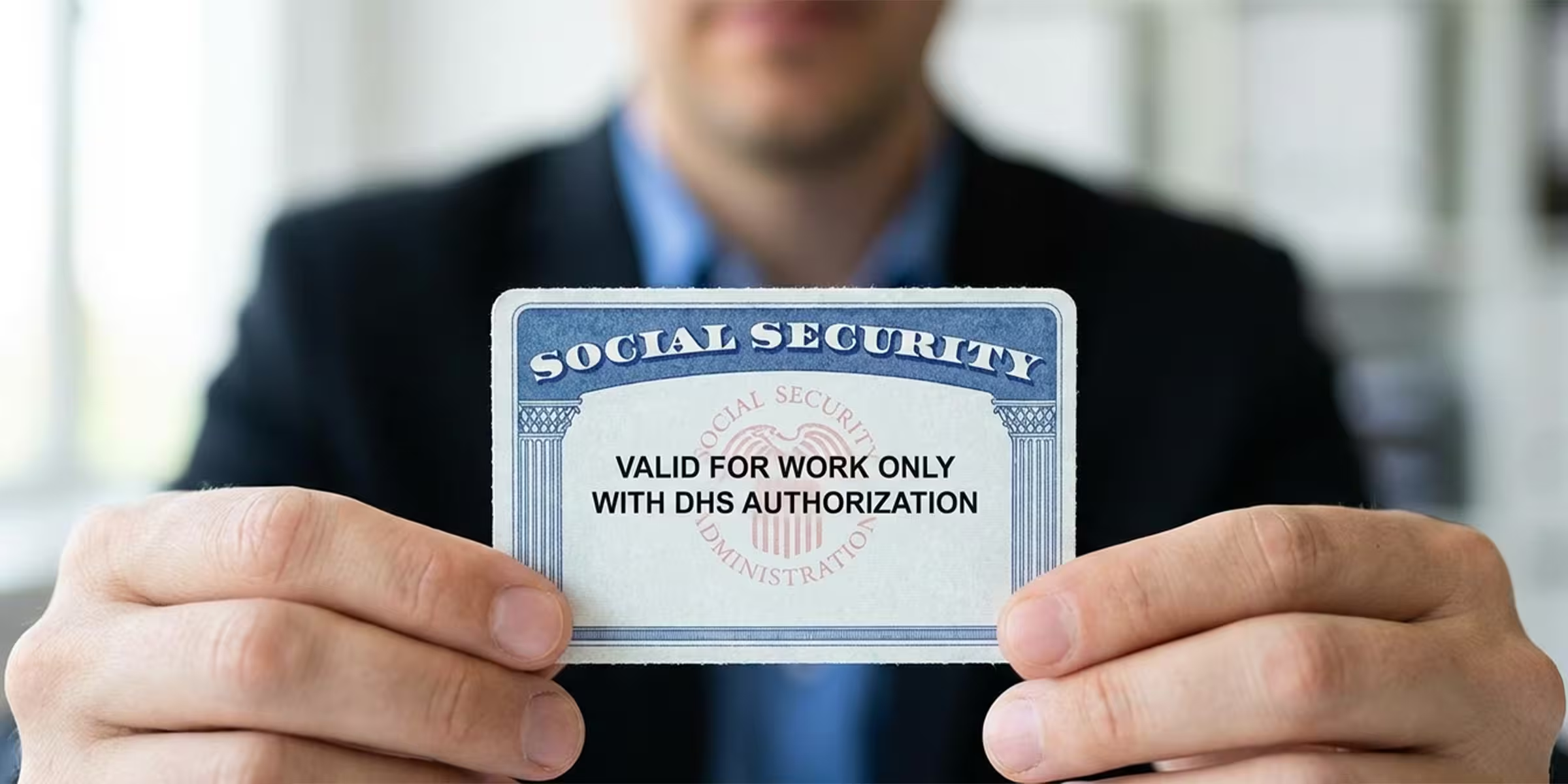



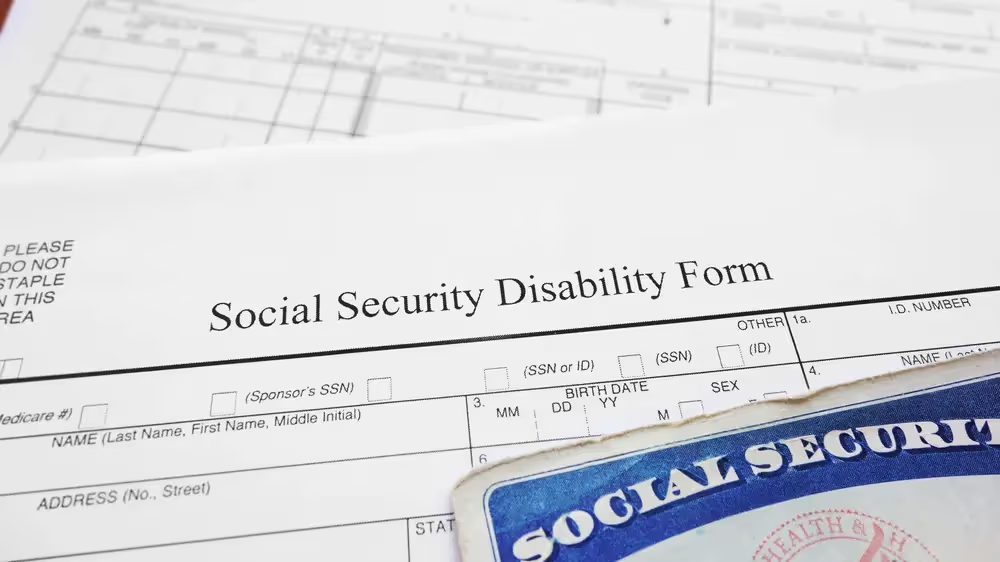
If your Social Security card displays the words "valid for work only with DHS authorization," you have a restricted Social Security card. The card itself is issued by the Social Security Administration (SSA) but the legend appears because the Department of Homeland Security (DHS) has granted work authorization under specific conditions, and the SSA reflects that restriction on the card it issues.
This endorsement appears on SSA cards issued to certain noncitizens who have been lawfully admitted to the United States on a temporary basis and authorized to work under specific DHS-approved conditions. Below, you'll find everything you need to know about what the legend means, who receives it, what employers and employees need to know, and how to replace or update your Social Security card if your status changes, and how GOV+ can help you with that.
What the "Valid for Work Only" Restriction Means
The legend "valid for work only with DHS authorization" is a restriction printed on certain Social Security cards. It does not mean the Social Security number itself is invalid — the SSN is fully legitimate and functions like any other. What the legend does mean is that the card alone is not enough to prove you are authorized to work in the United States.
The restriction reflects your employment eligibility status, which is separate from your immigration status. In other words, having a valid visa or immigration document does not automatically mean you have work authorization. DHS must specifically approve your right to work, and until that approval is confirmed through official documentation, the SSA card cannot be used on its own as proof of employment eligibility.
Think of the legend as a flag for employers: it signals that additional documentation is required before the card can be accepted as work authorization proof.
Who Receives a Restricted Social Security Card
Not everyone who applies for a Social Security card receives the same type. U.S. citizens and lawful permanent residents are generally issued unrestricted cards, meaning no legend appears, and the card can be used freely as proof of identity and work authorization.
A restricted Social Security card with the "valid for work only with DHS authorization" legend is issued to noncitizens who have been lawfully admitted to the United States on a temporary basis and have received work authorization from DHS. This includes categories such as temporary workers and certain visa holders whose right to work is tied to a specific DHS approval and is not permanent or unconditional.
The type of card the SSA issues depends on the person's current immigration status and the documents they present at the time of application. If that status changes, for example, if a temporary worker becomes a lawful permanent resident, the card type may need to be updated to reflect the new status.
Can You Work With This Card?
Yes, but not with the card alone. A restricted Social Security card does not by itself prove that you are authorized to work in the United States. To legally work, you must also have valid DHS work authorization, typically confirmed through an official Employment Authorization Document (EAD) or another accepted DHS-issued document.
The card and the work authorization work together: the SSA card establishes your Social Security number, while your DHS documentation confirms your employment eligibility. During the Form I-9 process, employers verify identity and employment authorization through acceptable I-9 documents — the Social Security card itself is not what establishes your right to work.
Employer Guidance: Form I-9 and Restricted Social Security Cards
Fix 4 — Employer guidance (critical)
Here's the corrected section:
Employer Guidance: Form I-9 and Restricted Social Security Cards
When a job applicant presents a Social Security card marked "valid for work only with DHS authorization," employers cannot accept it as proof of work authorization and unlike an unrestricted Social Security card, a restricted card is not acceptable for Form I-9 purposes at all. Federal law requires all employers to complete Form I-9 for every new hire, verifying both identity and employment eligibility before work begins.
The I-9 process uses three document lists to determine what is acceptable:
- List A documents establish both identity and work authorization on their own. A valid Employment Authorization Document (EAD) issued by DHS is a common example for noncitizens with temporary work authorization.
- List B documents establish identity only, such as a state-issued driver's license or ID card.
- List C documents establish work authorization only. An unrestricted Social Security card qualifies as List C; a restricted one does not.
Example: If an applicant presents a restricted SSA card, the employer should explain that it cannot be accepted for I-9 purposes and ask the applicant to present either a single List A document, such as a valid EAD, or a combination of a List B identity document and a different List C work authorization document.
Employers should never use the presence of a restricted card to make assumptions about an applicant's immigration status. The restriction reflects the SSA's record of the person's DHS work authorization conditions, nothing more.
Employee Guidance: What You May Need to Show
If your Social Security card carries the "valid for work only with DHS authorization" legend, it cannot be used for Form I-9 verification purposes. You will need to present other documentation that establishes both your identity and your employment eligibility.
For most noncitizens with temporary work authorization, the most straightforward option is to present a single List A document, which covers both identity and work authorization in one:
- A valid Employment Authorization Document (EAD) issued by DHS is the most common List A document for this situation.
- Some noncitizens may also be able to present other DHS or USCIS-issued documents as List A, such as a Form I-94 Arrival/Departure Record combined with supporting documentation, depending on their visa category and status.
If you do not have a List A document, you can instead present a combination of a List B identity document (such as a driver's license or state-issued ID) and a List C work authorization document (such as an unrestricted Social Security card, if you have one, or another accepted document). Your restricted SSA card cannot fill the List C role.
The exact documents that will satisfy your I-9 requirement depend on your current visa category and work authorization status. If you are unsure which documents apply to your situation, consult the current USCIS I-9 acceptable documents list at uscis.gov before your first day of work.
If your status changes: If you become a lawful permanent resident or otherwise gain unrestricted work authorization, your restricted Social Security card will no longer accurately reflect your status. In that case, you can apply to the SSA for a replacement Social Security card without the restriction, using documentation that confirms your updated status.
How to Get, Replace, or Update Your Social Security Card
The process for obtaining or updating a Social Security card runs through the Social Security Administration and varies depending on whether you need a card for the first time, a replacement for an existing card, or a corrected card that reflects a change in your status.
Getting a card for the first time
If you are a noncitizen applying for your first SSA card, you will need to provide documents that verify your identity, your immigration status, and your DHS work authorization. If your work authorization is temporary or conditional at the time of application, the SSA will issue a restricted card with the "valid for work only with DHS authorization" legend. The specific documents required depend on your visa category and current status — check ssa.gov for the current document requirements before applying.
Replacing a lost or damaged card
If your restricted Social Security card has been lost or damaged and your underlying work authorization status has not changed, you can apply to the SSA for a replacement card. The replacement will carry the same restriction as the original. If you're wondering how long the process takes, we've covered Social Security card replacement timelines in detail.
Correcting your card after a status change
If your immigration or work authorization status has changed, for example, you have become a lawful permanent resident or received unrestricted work authorization from DHS, you can apply to the SSA to have the restriction removed and a corrected replacement Social Security card issued. You will need to bring documentation confirming your updated status. The SSA will verify your documents and issue a new card without the restriction.
In all cases, the specific documents required will depend on your individual category and current status. Keep in mind that replacement processing times can vary. See how long it takes to replace a Social Security card before you apply.
Where GOV+ Helps in the Process
Applying to the SSA for a restricted Social Security card, a replacement, or a status correction means showing up to your field office with the right documents and a complete, accurate Form SS-5 package — any missing information or errors can mean a second trip. GOV+ is designed to make that visit go smoothly the first time.
If you need to replace or update your Social Security card, here's how GOV+ can help:
- We prepare your complete Form SS-5 application package so you don't have to navigate the process on your own.
- Our expert reviewers check your application for errors and missing information before your field office appointment.
- GOV+ walks you through exactly which identity, immigration status, and work authorization documents to bring for your specific situation — so nothing is missing when you arrive.
- Identity theft protection with up to $1M coverage keeps your information secure after your card is issued.
Ready to get started? Replace your Social Security card with GOV+.
Frequently Asked Questions
What does "valid for work only with DHS authorization" mean on a Social Security card?
This legend means the cardholder's employment eligibility depends on active DHS work authorization. The card itself does not prove the right to work — additional DHS-issued documentation is required.
Can I work with a restricted Social Security card?
Yes, provided you also hold valid DHS work authorization. The card establishes your Social Security number, but your Employment Authorization Document or another accepted DHS-issued document is what confirms your eligibility to work.
Is a restricted Social Security card the same as a green card?
No. A green card establishes lawful permanent resident status and comes with unrestricted work authorization. A restricted Social Security card is an SSA-issued document that reflects a work-related limitation tied to your current DHS authorization status.
Can an employer accept a restricted Social Security card for Form I-9?
No. Unlike an unrestricted Social Security card, a restricted card is not acceptable for I-9 verification purposes. Employers must ask for a valid List A document — such as an Employment Authorization Document — or a combination of List B and List C documents.
How do I remove the restriction from my Social Security card?
Once your immigration or work authorization status changes — for example, after becoming a lawful permanent resident — you can apply to the SSA for a corrected replacement Social Security card. You will need to bring documentation confirming your updated status to support the request.
References:
- Social Security Administration. Types of Social Security Cards. https://www.ssa.gov/ssnumber/cards.htm
- Social Security Administration. Your Social Security Number and Card. https://www.ssa.gov/pubs/EN-05-10002.pdf
- Social Security Administration. Social Security number & card. https://www.ssa.gov/number-card
- U.S. Citizenship and Immigration Services. Form I-9, Employment Eligibility Verification Instructions / Acceptable Documents. https://www.uscis.gov/i-9-central/form-i-9-acceptable-documents
- Social Security Administration. History of Design Versions of the SSN Card. https://www.ssa.gov/history/ssn/ssnversions.html
- Social Security Administration. Social Security History FAQs. https://www.ssa.gov/history/hfaq.html
- Social Security Administration. Social Security Administration § 422.105. https://www.ssa.gov/OP_Home/cfr20/422/422-0105.htm
- U.S. Government Publishing Office. 20 CFR § 422.104 / SSA card rules. https://www.govinfo.gov/content/pkg/CFR-2024-title20-vol2/pdf/CFR-2024-title20-vol2-sec422-104.pdf