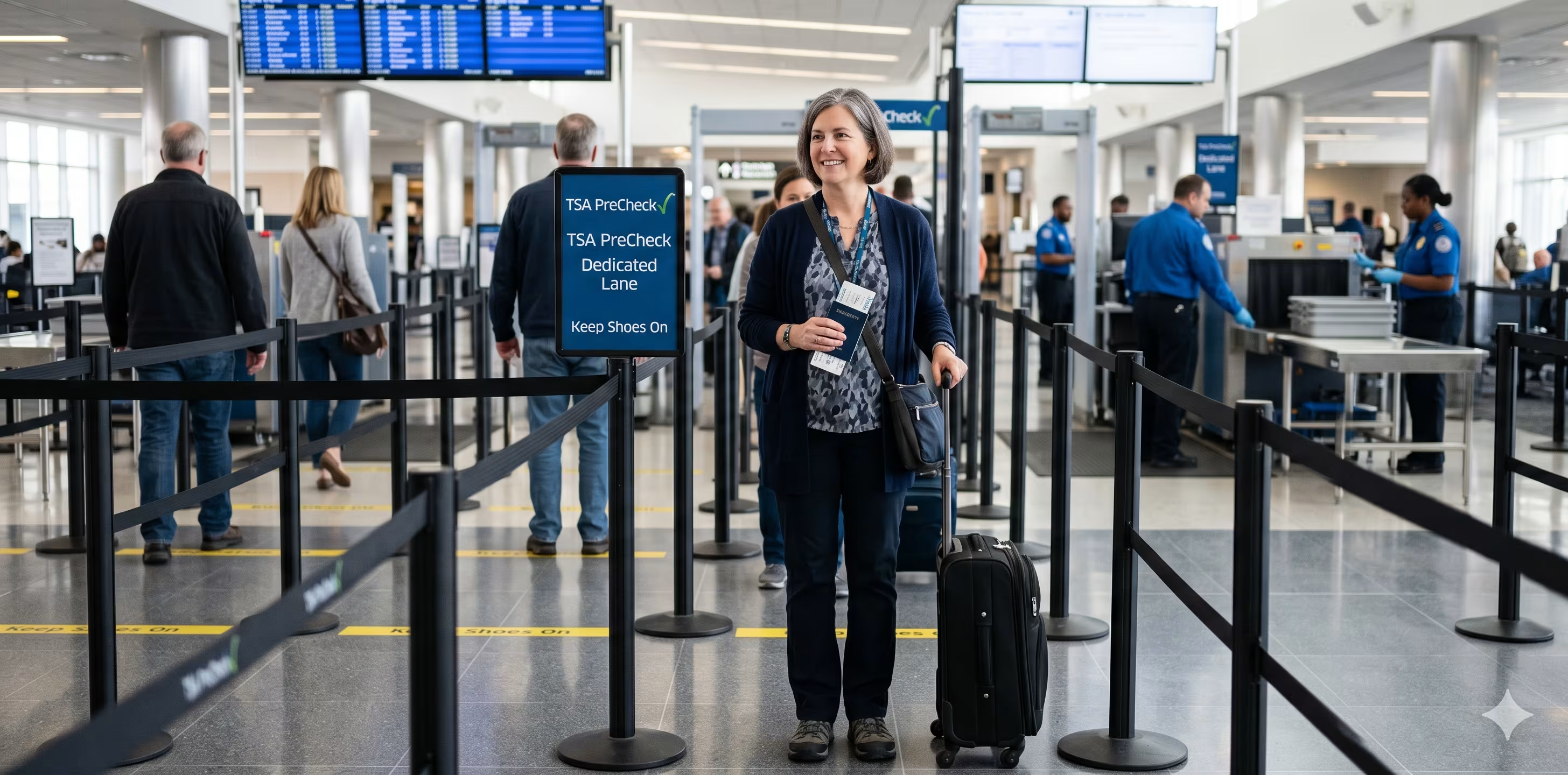
Most new applicants get their TSA PreCheck Known Traveler Number (KTN) within 3 to 5 days after their in-person enrollment appointment. From the moment you start your online application to the moment you receive your KTN, plan for about one to four weeks total — with the biggest variable being how quickly you can schedule your appointment.
Renewals are faster: the process is fully online for most people and typically takes a few days. GOV+ helps you complete your application and book the earliest available appointment in one flow, cutting the pre-appointment stretch down significantly.
The three phases and how long each takes
Getting TSA PreCheck involves three separate steps. Understanding where time is actually lost helps you move faster.
Phase 1: Online application — about 5 minutes
The online application asks for basic identity information, citizenship or residency status, and a short series of yes-or-no background questions. If you have your government-issued ID and proof of citizenship in front of you, it takes about five minutes. Most applicants spend more time searching for documents than filling out the form.
What slows it down: names that don't match across documents, missing citizenship documents, or incomplete address history. Having everything ready before you start is the single biggest time-saver at this stage.
Phase 2: Enrollment appointment — 10 minutes in person, days to schedule
After submitting the online application, new applicants must complete a 10-minute in-person appointment at a TSA-authorized enrollment center. The appointment itself is brief — an agent verifies your identity, takes fingerprints, and photographs you. The scheduling wait is what eats up time, as there is no walk in available.
Enrollment centers are operated by IDEMIA, CLEAR, and Telos at hundreds of locations across the country, including airports, retail locations, and provider offices. Appointment availability varies widely by location and season.
Best case: an appointment at a nearby center within one to two days
Common case: five to ten days at a convenient location
If you only check one center: potentially three to four weeks
The fastest move here: check multiple enrollment provider centers within a reasonable driving distance. A center 20 miles farther away often has availability days or weeks sooner. GOV+ surfaces the nearest open slots across enrollment centers rather than one center at a time, which speeds up the scheduling step considerably.
Phase 3: TSA processing — 3 to 5 days, sometimes up to 60
After your appointment, TSA processes the application and issues a Known Traveler Number by email. The TSA publishes an average turnaround of 3 to 5 days for most applicants. A smaller share of applications go into extended security screening — typically for background check clarifications — which can stretch to 60 days. This phase is entirely on the government's side and cannot be expedited.
Full timeline from start to KTN
Scenario
Application
Appointment wait
TSA processing
Total estimate
Best case (new applicant)
5 minutes
1–2 days
3–5 days
~1 week
Typical case (new applicant)
5–10 minutes
5–10 days
3–5 days
~2 weeks
Slower appointment availability
5–10 minutes
Rule of thumb: budget 30 days from start to KTN for a comfortable margin. If everything lines up — documents ready, a nearby appointment available, straightforward background check — you could have your KTN in a week.
How TSA PreCheck renewals are faster
If you already hold TSA PreCheck and are renewing, the process skips the in-person appointment entirely for most applicants. TSA PreCheck is valid for five years, and renewal is handled fully online: confirm your information, pay the renewal fee, and receive a confirmation. New fingerprints are not required for most renewals.
The renewal application takes under five minutes. TSA processing adds a few more days. Most renewals resolve in about a week.
TSA recommends starting the renewal process up to six months before your expiration date — but no earlier than six months out. Don't let TSA PreCheck expire: if it lapses, you'll need to re-enroll as a new applicant, which means an in-person appointment and a longer wait.
GOV+ handles the renewal end-to-end online and sends renewal reminders before your expiration date so you never lose your PreCheck status unexpectedly.
What you can do right now to move faster
1. Gather your documents before you open the application. You'll need a government-issued photo ID (driver's license or U.S. passport) and proof of citizenship or legal status (U.S. passport, birth certificate, or permanent resident card). Having both in hand means no mid-application pauses.
2. Check multiple enrollment centers. Don't default to the closest one. Look at two or three options within a 30-minute radius. The extra drive is almost always worth it if it shortens your wait by two or three weeks.
3. Check weekends and early-morning slots. Less popular times often have more availability. Look at the full calendar before settling on a date.
4. Add your KTN to all airline profiles the day it arrives. Once TSA emails your Known Traveler Number, add it immediately to every airline loyalty account and existing reservation. Your boarding pass won't show the PreCheck indicator until the KTN is attached to the reservation, and you will still have to go through airport security.
5. Check your credit card benefits before paying. Many travel credit cards reimburse the TSA PreCheck enrollment fee as a standard benefit. Check before paying out of pocket.
Who qualifies — and who doesn't need to apply
TSA PreCheck is available to U.S. citizens, U.S. nationals, and lawful permanent residents. Applicants go through a background check; a disqualifying criminal record or outstanding warrants will result in denial.
A few groups don't need to apply at all:
Active-duty military members qualify automatically and can use their DoD ID number as their Known Traveler Number — no application required.
DoD federal civilian employees must opt in before using their DoD ID number as their KTN.
Global Entry members already have TSA PreCheck included. If you're considering both programs, apply for Global Entry first — approval includes TSA PreCheck, so a separate PreCheck application isn't needed.
Global Entry vs. TSA PreCheck: which is faster to get?
If you travel internationally, Global Entry is often the smarter choice even though the approval timeline tends to be longer. Global Entry costs $120 (vs. $85 or less for TSA PreCheck) and includes TSA PreCheck as a benefit. The application requires an in-person interview at a Global Entry Enrollment Center, and conditional approval can take weeks to months.
For domestic travelers, TSA PreCheck is quicker to obtain and costs less. For international travelers, the extra time and cost of Global Entry pays off.
Apply for TSA PreCheck with GOV+
GOV+ makes the application kit straightforward — no government websites to navigate, no paper forms, no guesswork about which documents you need.
What GOV+ handles:
Simple online application kit — fill out one form, we prepare everything you need
Eligibility check — confirm you qualify before you spend time on the process
Appointment scheduling — we find and book the nearest available slot for you
Document guidance — know exactly what to bring so you don't face delays
Real-time tracking — see where your application stands at every step
Renewal reminders — automatic alerts before your PreCheck expires so you never lapse
Best case: submit the application today, get an appointment within two days, receive your KTN in about a week. Under typical conditions, plan for two to four weeks from application to KTN. If you're in extended review, up to 60 days.
Can I use TSA PreCheck before my KTN arrives?
No. Your KTN must be added to your airline reservation, and your boarding pass must display the TSA PreCheck indicator. Until the KTN is issued and added, you go through standard screening.
Does my appointment wait time affect when TSA starts processing?
Yes. TSA processing doesn't begin until after your in-person appointment is complete. Every day you delay scheduling the appointment is a day added to the overall timeline.
Is there any way to speed up TSA processing after my appointment?
No. Once your appointment is done, the background check and KTN issuance are fully on TSA's timeline. The 3-to-5-day average is not guaranteed and cannot be expedited.
How long does TSA PreCheck last?
Five years from the date of initial approval. Renewals can be started up to six months before expiration.
What happens if my TSA PreCheck expires before I renew?
You lose access to the PreCheck lane immediately upon expiration. If you let it lapse, you'll need to apply as a new applicant, which requires a new in-person appointment.
How much does TSA PreCheck cost in 2026?
New enrollment is $85 or less for a five-year membership. Many travel credit cards reimburse this fee as a benefit. Children 12 and under traveling with an enrolled adult do not need their own enrollment.
Guy Lelouch
About the author
Guy Lelouch, founder and CEO of GovPlus, drives government digital transformation with his expertise in technology and public policy by creating efficient, transparent, and user-friendly services.
Skip the airport security line
Your TSA PreCheck application, started in minutes. Five years of faster security, every trip.